
Spray Polyurethane Foam Roofing in Shreveport, LA
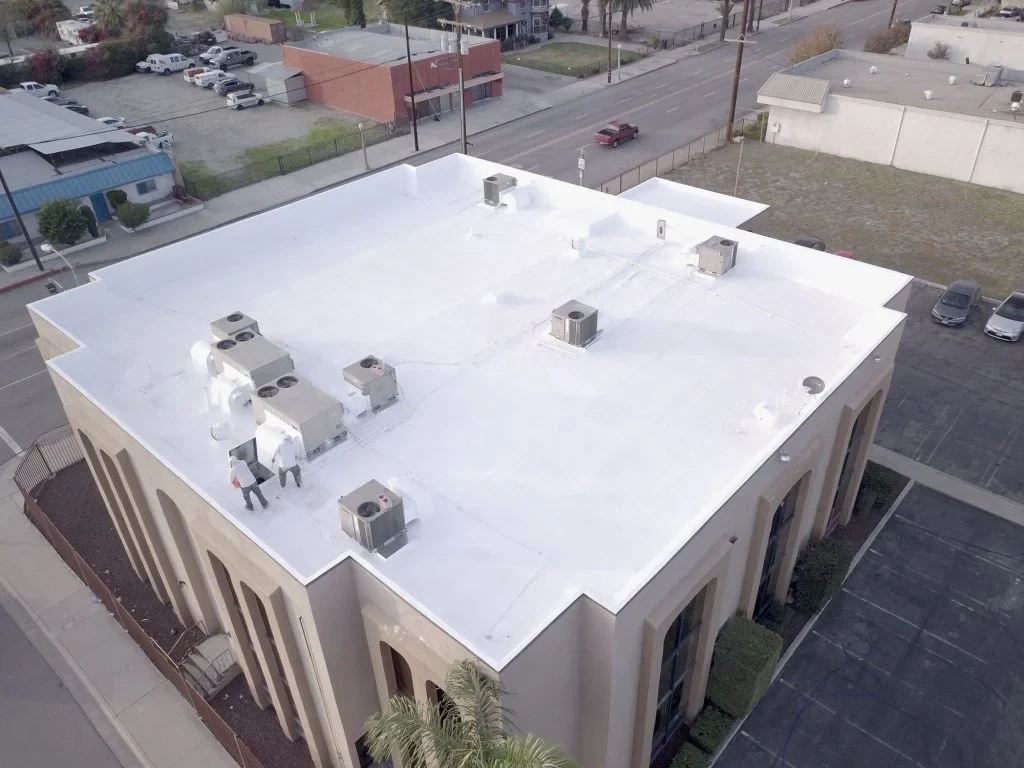
Spray Foam for Irregular Rooflines and Retrofit Insulation Gaps
Spray polyurethane foam is the system we bring up when a roof deck has more going on than a flat, uniform field: penetrations clustered unevenly, old mechanical curbs from equipment that's since been removed, or a roofline that was added onto in pieces over decades. Older industrial and municipal buildings around Shreveport tend to have exactly that kind of deck, and foam's ability to conform to irregular geometry solves problems a sheet membrane can't without extensive custom flashing.
Continuous Coverage Around Obstacles
Spray-applied foam self-levels and conforms around curbs, pipe clusters, and odd transitions in a way that a rolled membrane physically can't without a lot of hand-cut detail work. On a municipal building or older plant with decades of accumulated rooftop penetrations, that continuous coverage reduces the number of individual flashing details a crew has to build correctly, which is also fewer places for a future leak to start.
We still detail every penetration properly rather than assuming the foam alone solves the transition, but the base coverage gives us a better starting point on a complicated deck than a sheet membrane would.
Adding R-Value to Buildings That Never Had It
A lot of older commercial and industrial buildings in this market were built with minimal or no roof insulation, because energy codes at the time didn't require it and utility costs weren't the driver they are now. Spray foam adds real insulation value directly at the roof deck during the same project that addresses waterproofing, which is a meaningfully different value proposition than a membrane-only recover that leaves the building's insulation gap exactly where it was.
For a building on a tight capital budget where a separate insulation retrofit project was never going to get funded on its own, bundling that improvement into the roofing project is often the only realistic way it happens.
Humidity and Dew Point During Application
Foam application is unforgiving about substrate moisture and dew point conditions in a way that some other systems aren't. Spraying foam onto a damp deck, or in conditions where dew point is close to substrate temperature, traps moisture and creates adhesion problems that don't show up until later. Ark-La-Tex humidity makes this a real scheduling constraint, not a theoretical one, and we hold application when conditions aren't right rather than pushing through to keep a schedule.
- Deck moisture and dew point check before any foam application begins
- Substrate cleaning and prep at every existing penetration and curb
- Foam thickness applied to specified R-value target across the field
- Protective coating applied over foam per manufacturer requirements
- Post-application inspection for coverage consistency and pinholes
Protective Coating and UV Exposure
Foam itself isn't UV-stable and needs a protective coating over it, typically silicone or acrylic, applied at a specified thickness. That coating is what actually takes the sun exposure over the life of the roof, and it needs periodic recoating on a schedule tied to UV exposure and foot traffic rather than a one-time application that's expected to last the life of the roof.
We build that recoating interval into the maintenance conversation up front, because a foam roof that isn't recoated on schedule loses its protective layer well before the foam substrate itself would otherwise need replacement.
Where Foam Isn't the Right Answer
Foam isn't the default recommendation for a straightforward flat roof without unusual geometry or insulation gaps. On a building where a standard single-ply membrane solves the problem at lower cost and simpler long-term maintenance, we'll say so rather than pushing foam because it's a more involved, higher-margin project. Foam earns its place specifically on the complicated decks and insulation-poor buildings where it solves problems other systems can't.
We also flag foam as a poor fit on roofs with heavy foot traffic or storage, since the protective coating takes more wear in those conditions than it does on a low-traffic industrial roof.
Foam Projects on Municipal and Public-Building Budgets
Municipal buildings and public facilities in this area typically move through a bond or budget-approval cycle before a roofing project gets funded, which is a slower process than a private owner deciding to move forward on a proposal. We build project timelines around that reality, including phased foam application across fiscal years when a full-building project doesn't fit one year's approved budget.
We'll also provide the documentation a public procurement process usually requires, including itemized scope and specified R-value targets, so the project can move through approval without a facilities director having to translate our recommendation into whatever format the finance office needs.
Questions Facilities Managers Ask About Spray Foam Roofing
Does spray foam work on any roof, or only irregular ones?
It works on any roof, but it earns its cost specifically on decks with complex geometry, accumulated penetrations, or missing insulation. On a simple flat roof, a membrane system is often the more cost-effective choice.
How much does foam actually add in R-value?
That depends on the applied thickness, which we spec to a target R-value based on the building's current insulation gap and budget.
Can foam be applied in Shreveport's summer humidity?
Only within the right dew point and substrate moisture window. We monitor conditions closely and hold application rather than spraying onto a damp or borderline deck.
How often does the protective coating need reapplication?
It depends on UV exposure and foot traffic, but we build a recoating interval into the maintenance plan rather than treating the first coating as a lifetime application.
Is foam roofing more expensive than a membrane recover?
Often comparable or higher upfront, but on a building with real insulation gaps, it's addressing two problems in one project rather than one, which changes the value comparison.